Wallick Soldiers of the American Civil War
Washington Wallick
1st California Infantry, Co. N | 71st Pennsylvania Volunteer Infantry
Born
1836 · Tuscarawas County, Ohio
Age at Enlistment
25
Occupation
Carpenter
Enlistment Place
Philadelphia, Pennsylvania
Physical Description
5′ 9″ · Light hair · Gray eyes
Died
May 7, 1899 · Philadelphia, Pennsylvania · Age 63
Rank
Private
Enlisted
July 8, 1861
Discharged
Aug. 18, 1862
Service
354 days
Family Lineage
Washington · son of Zachariah · son of “Peru” Benjamin Sr. · son of Johannes · son of Hans Michael Wallick
Biography
Washington Wallick was part of the Benjamin Wallick Sr. clan who in the mid-nineteenth century migrated from Tuscarawas County, Ohio, to Miami County, Indiana. The family settled in the small town of Peru, Indiana. In April of 1861, President Lincoln made a call to arms for all the northern states to put down the southern rebellion. Three months later, Washington became yet another member of the Miami County Wallick family who volunteered to quash the Rebel insurrection.
Although he was raised in Peru with nine close relatives who also served, by 1861 Washington had moved to Philadelphia, Pennsylvania, and it was there where he enlisted in the Union army. There is little mystery as to why Washington left his Indiana hometown to become a Philadelphian. We know that he and his wife, Ellen, married in 1854 in Peru at a young age (both were only 18 or 19 years old) and by the summer of 1861 they had moved and established their home in Philadelphia. The 1860 United States census states that Ellen was from Pennsylvania, so it seems Washington decided to leave his mother, father, and six siblings in order to live near Ellen's relatives. No one else from Washington's branch of the family ever moved so far away from Peru. Other than his wife, all of Washington's immediate family members are buried in and around Miami County, Indiana.
The California Brigade
Washington was recruited to be part of a new four-regiment brigade of eastern men. The creation of this brigade has a few interesting features in its origins when compared to how most Civil War units were formed. At the time of the war, most regiments and brigades were organized by highly-regarded, ambitious men from one particular state, and the companies within the regiments were generally men from the same town or county of that state. But Washington Wallick joined an outfit organized by an Illinois lawyer who, at the time, was an Oregon Senator that had recently moved from San Francisco, and who was commissioned by President Lincoln to raise a brigade of soldiers from Philadelphia and New York City — all to fight in the name of the State of California.
Immediately after the firing on Fort Sumter, the President had assigned his close friend and ally, Senator Edward D. Baker, the job of raising a brigade of four regiments of soldiers who would fight as surrogates for the citizens of California. California had come into the Union as a free state in 1850 and, considering the great distance troops and matériel had to travel in order to engage in battle, the state thought it best to let eastern men fight under the Golden State banner. Lincoln awarded Senator Baker, who also had extensive military experience, a colonelcy of volunteers to lead the brigade.
Washington enlisted on July 8, 1861, just a few weeks before the First Battle of Bull Run. Seven weeks later, he was mustered into Federal service and became part of the 1st California Infantry Regiment. This outfit had fifteen companies instead of the usual ten — that is why Washington was in Company N — and they were mostly comprised of Philadelphians. There were three other regiments organized that summer by Senator Baker: the 2nd, 3rd, and 5th California Infantry. All four regiments became known as “The California Brigade.”
The brigade had its first real taste of combat on October 21, 1861, at the disastrous affair called the Battle of Ball's Bluff. It was by no means a major engagement, but it did have huge political ramifications. Officers' incompetence combined with inexperienced troops created the expected result — a defeat and major embarrassment for the Federal army. Also, one of the more capable commanders was mortally wounded in the battle: Senator Edward Baker. He is still the only sitting senator ever to be killed in action on an American battlefield. After his death, a congressional committee called the Joint Committee on the Conduct of the War was created to investigate Ball's Bluff and oversee the Federal army's future military affairs. Throughout the war, this collection of congressmen became a constant thorn in the side of the President and his generals.
After the Ball's Bluff fiasco, the California Brigade was reorganized into four Pennsylvania Volunteer Infantry (PVI) regiments: the 69th, 70th, 71st, and 109th. These four regiments then became known as the “Philadelphia Brigade.” Washington was officially assigned to the 71st PVI — a regiment that went on to fight in some of the war's most famous battles:
- Ball's Bluff (as the 1st California Regiment)
- Battle of Fair Oaks / Seven Pines
- Malvern Hill
- Battle of Antietam
- Battle of Fredericksburg
- Chancellorsville
- Gettysburg — The Angle
- Wilderness
- Spotsylvania Court House
- North Anna
- Cold Harbor
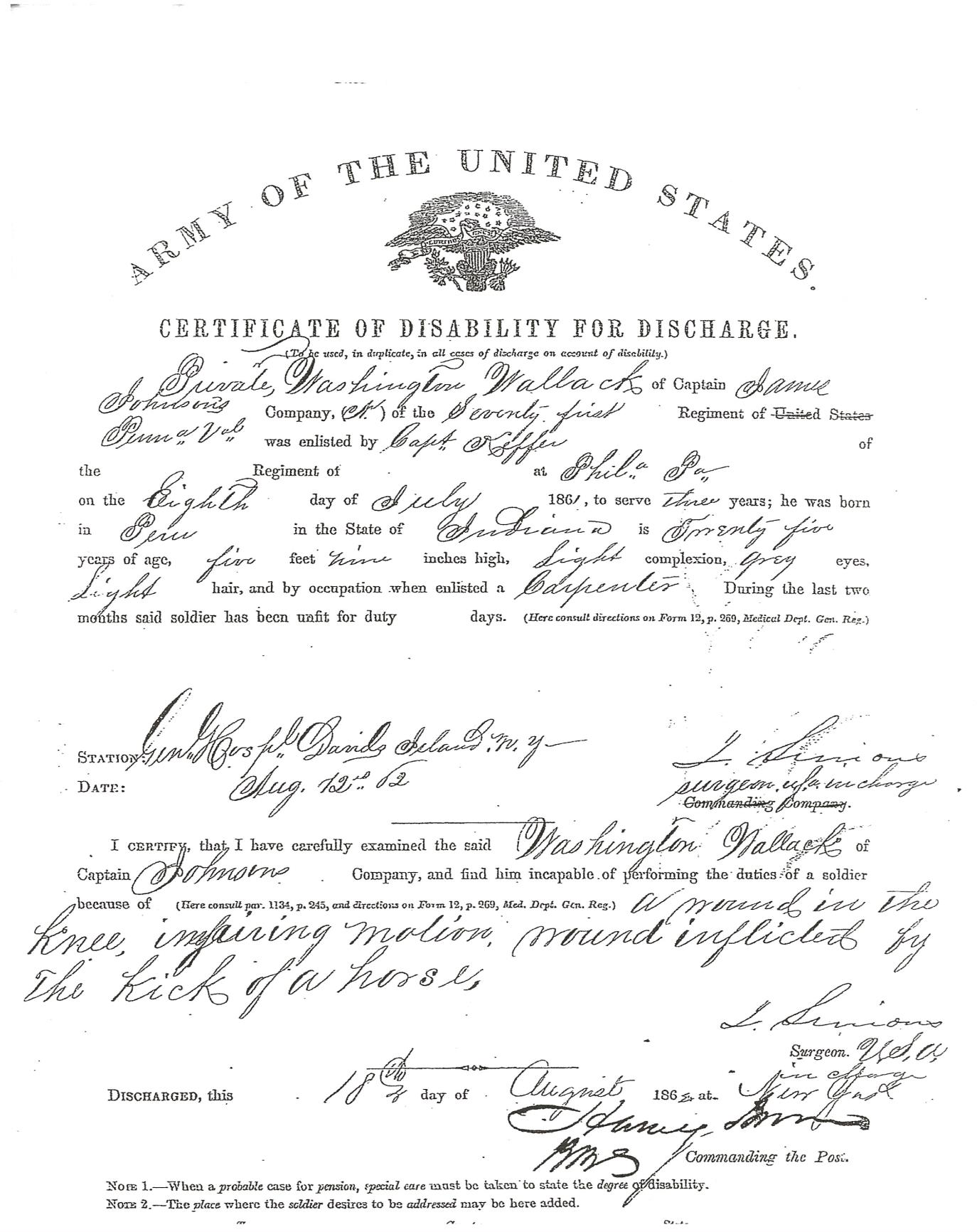
When this author saw the stellar resumé the 71st PVI had acquired during the war, it was with tremendous excitement and anticipation that he began his research into Washington Wallick. However, the author soon discovered a disappointing reality to the Philadelphian's war story. Unfortunately for the author, but fortunately for his subject, Washington was in none of these battles. On September 20, 1861, at Falls Church, Virginia, even before the regiment's engagement at Ball's Bluff, Washington was kicked and tramped upon by a horse, which severely injured his left knee. This injury ended his useful service to the Union army and the disability plagued him for the rest of his life. Below is what little we know about Washington's service in the American Civil War, as can be gleaned from his compiled military service records (CMSR) and pension records.
Crippling Injury Before the Fighting Ever Began
“At the Battle of Falls Church, VA, September 20, 1861, Washington Wallick received a compound fracture of the left knee by a horse knocking him down and tramping on him while in action and engaged with the enemy. I have knowledge of [the] occurrence by being an eyewitness, being in the same company…”
Washington began his home furlough on October 26, 1861 — well over a month after the injury before he had proper treatment for his knee. His company records show him recuperating in Philadelphia during November and December, with nothing written for January and February 1862. March and April found Washington back with his unit. But in May, June, and July his compiled military service records (CMSR) only state “absent, sick and missing.” Although he was officially transferred to Company A of the 71st PVI, he never appeared on the company's muster roll. His knee affliction was permanent.
He was granted a disability discharge on August 18, 1862, while recuperating on David's Island, located just off the coast of New Rochelle, New York. He stayed on the island until October 18, then returned to Philadelphia as a civilian.
Service Record
July 8, 1861
Enlisted
Recruited by Captain Keffer in Philadelphia for three years of service. Proceeded to Fort Schuyler at the tip of the Bronx, New York, to await organization of the California Brigade.Aug. 29, 1861
Mustered into Federal Service
All soldiers of the 1st California Infantry mustered into Federal service. The brigade moved to Fortress Monroe, Virginia, then to Washington D.C. to help defend the capital.Sept. 20, 1861
Injured at Falls Church, Virginia
During a minor skirmish near Falls Church, Virginia, Washington was kicked in the left knee by a horse and trampled. The compound fracture ended his effective service before it had truly begun.Oct. 26, 1861
Home Furlough Begins
Washington began his furlough to Philadelphia for treatment — more than five weeks after the injury. He recuperated in Philadelphia through at least April 1862.Oct. 21, 1861
Battle of Ball's Bluff
Washington's regiment fought at Ball's Bluff without him. Senator Baker was mortally wounded. The California Brigade was subsequently reorganized as the Philadelphia Brigade (69th, 70th, 71st, and 109th PVI).May–July 1862
Absent, Sick and Missing
CMSR entries for these months read only “absent, sick and missing.” Although officially transferred to Company A of the 71st PVI, Washington never appeared on the company muster roll.Aug. 18, 1862
Disability Discharge
Granted a Certificate of Disability for Discharge while recuperating on David's Island, New Rochelle, New York. Total service: 354 days, of which only 53 were active.Oct. 18, 1862
Returns to Philadelphia
Left David's Island and returned to Philadelphia as a civilian. Immediately granted a pension of six dollars a month. In 1890 his pension was increased to eight dollars a month.Post-War Life
Washington's service as an effective soldier was ended before it ever began. After months of waiting for his knee to heal, Washington returned home to Philadelphia. His 1871, 1880, 1890, and 1896 pension affidavits state that the war injury made him limp and constantly drag his left leg, preventing him from returning to his old trade of carpentry. However, he applied his knowledge of carpentry in another way — Washington went into business for himself as a picture frame manufacturer.
It is possible that he could have overseen a thriving business for many years. But The Wallick Manufacturing Company eventually had some very serious economic troubles. It appears that the money problems continued up to his death and well beyond, for he left his wife, Ellen, in a financial mess.
When Washington died on May 7, 1899 of uremia (blood poisoning due to kidney disease), Ellen was left with two mortgages on their house, unpaid utility bills, and overdue property taxes, all totaling over $16,000 — over half a million dollars in 2023 terms. Their home was mortgaged at twice the market value and was in Ellen's name alone, perhaps to shield it from Washington's business woes. According to her pension affidavits, Ellen was totally unaware of how badly Washington was in debt.
By June of 1900, Ellen was 64 years old and very destitute. Her widow's pension application had yet to be approved and, other than being paid for some “day labor,” she had received no income for over 13 months. Washington and Ellen had no children. She did receive some assistance from others in her Philadelphia family. Ellen died of bronchial pneumonia on March 30, 1916. The only assets she owned at the time of her death were “$30 cash and a few household effects of no value,” according to a deposition made by Washington's second cousin and executor of Ellen's estate, Maude Wagner.
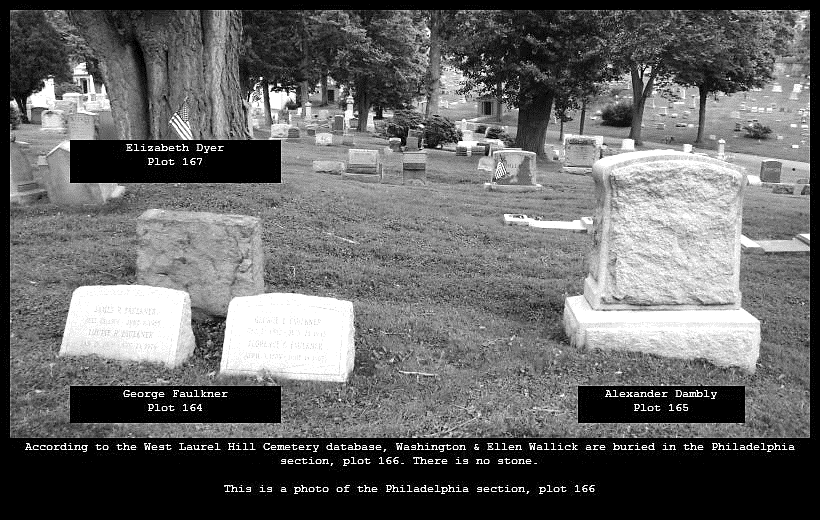
Washington Wallick's service as an effective soldier was ended before it ever began. There is little to say about his time in the Union army other than that after seven weeks as a private he was kicked in the knee by a horse and disabled for life. Had that incident not occurred, and given the history of his regiment, he could have had one of the most interesting narratives of all the Wallicks who served in the American Civil War.
Comrades-in-Arms
Brother
Jeremiah Wallick
109th IVI
Uncle
Benjamin Wallick Jr.
109th IVI
Uncle
Christopher Wallick
109th IVI
Uncle
Wesley Wallick
109th & 138th IVI
Cousin
William F.M. Wallick
13th, 109th & 151st IVI
Cousin
Charles F. Wallick
87th IVI
Cousin
John Wesley Wallick
138th & 151st IVI
Cousin
Benjamin Wallick
162nd OVI
Cousin
William Wallick
51st IVI